San Francisco Tsunami Seiche
Cesium Developer Conference Agenda
A few months ago, I read an article about a seiche—a fancy name for a standing
wave created by a tsunami—set up in a fjord that subsequently caused a seismic
signal that was detected around the globe for the next 9 days
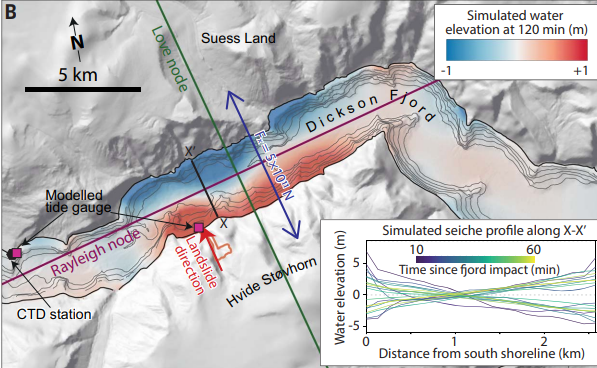 K. Svennevig et al., “A rockslide-generated tsunami in a Greenland fjord rang Earth for 9 days,” Science 385, 1196–1205 (2024).
When I heard the July 2025 tsunami was headed for San Francisco, I wanted to do things. The first
was to track its progress via tsunami bouy data. The second was to see if that tsunami would set up a
seiche in the San Francisco Bay. I wondered if we'd also see a standing wave in the Bay.
K. Svennevig et al., “A rockslide-generated tsunami in a Greenland fjord rang Earth for 9 days,” Science 385, 1196–1205 (2024).
When I heard the July 2025 tsunami was headed for San Francisco, I wanted to do things. The first
was to track its progress via tsunami bouy data. The second was to see if that tsunami would set up a
seiche in the San Francisco Bay. I wondered if we'd also see a standing wave in the Bay.
I found out the tsunami was on its way at around 10 PM in San Francisco. I rolled out of bed, and about
half ann hour later thanks to a lot of CesiumJS work I'd already done, and a bit more
LLM generated
code, I had the map up and running.
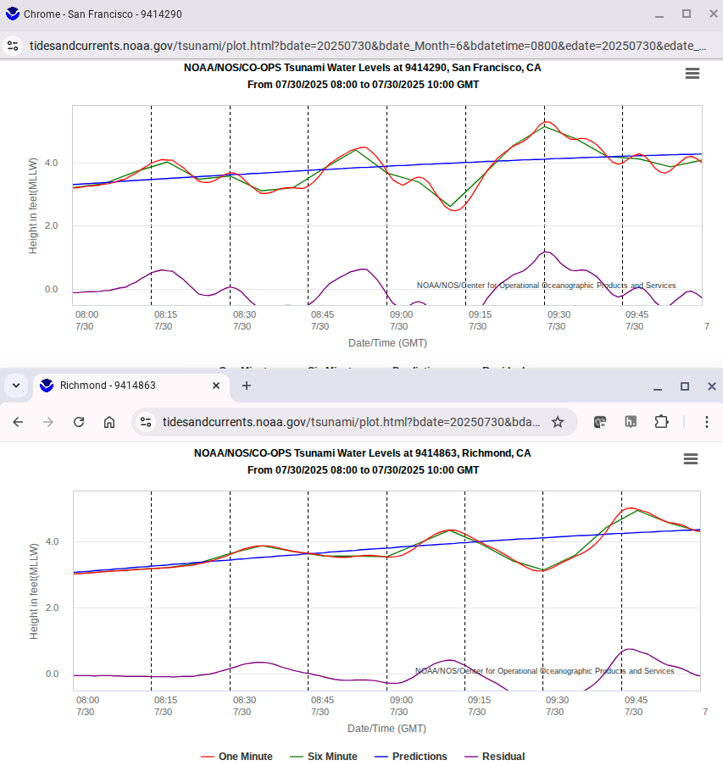
As for the seich, I noticed that there was definitely a wave in the residual
vs predicted tide data starting at the arrival time of the tsunami.
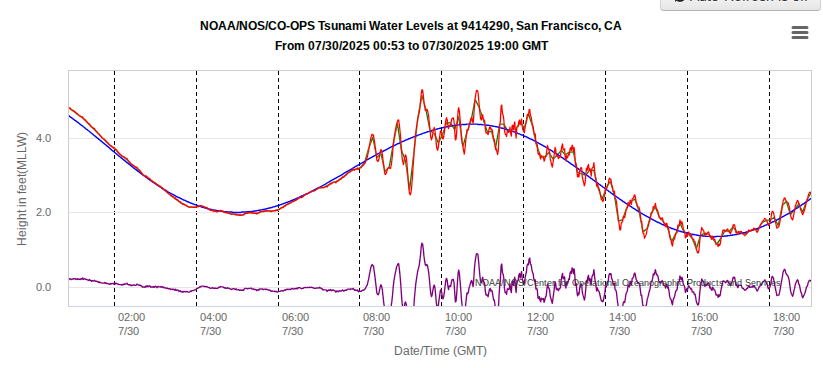
I worked out the period of that wave using an FFT in Google Sheets with the help of (once again) ChatGPT 4o.
Sure enough, the wave period corresponds pretty nicely to the initial velocity of the tsunami as it arrived in
San Francisco! The FFT of the wave at the Presidio station returned this chart
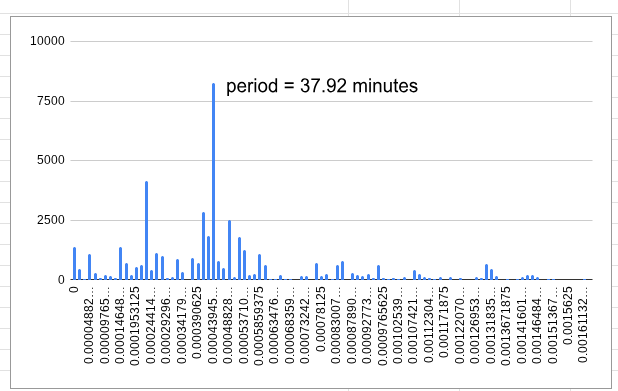
The first peak of the tsunami arrived at Richmond station 18 minutes after the first peak at the Presidio. If you assume that the wave maintained about the same speed, then doubling that time for the round trip transit between the two edges of the bay represented by those stations, you get 36 minutes, only two minutes period than the wave setup after the Tsunami arrived. I don't know for certain, but it looks like the tsunami wave is sloshing around in the Bay with a period that very closely matches what you'd expect using the speed of the initial tsunami wave as it traveled across the Bay!
In the figure below you can see the path between the two measuring stations.
It took the initial wave 18 minutes to travel from the Presidio station
to the Richmond measuring station. There are obstacles between the two stations. I'm ignoring
those for this 'back of the envelope' calculation.