Projects
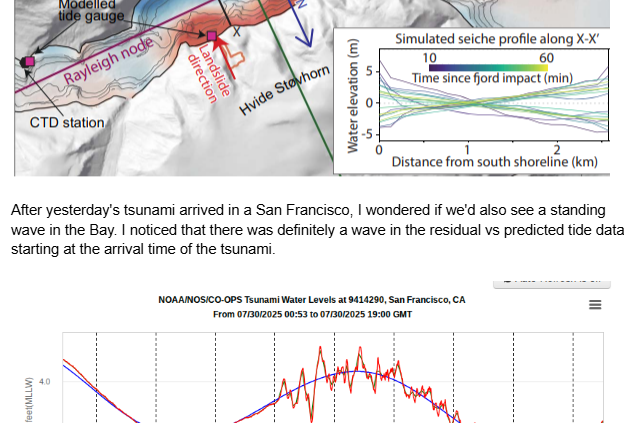
Seiche resonance in San Francisco Bay after the July 2025 tsunami
Seiche resonance process and results
Research notebook of a working engineer
Verification engineer with thirteen patents. Author of the book that kicked off metric the driven verification era. This channel collects the agentic AI work I can show publicly—projects built across embedded systems, GIS, historical research, and ham-radio control, often in collaboration with my kids.
Gas Town is the agentic AI orchestrator, Daize, the 15 year-old here, and I use for Gas Town introduced by Steve Yegge building code and research projects. For those new to generative AI, an AI agent is a LLM like GPT or Claude that uses tools to accommplish a complete task for the human user. That task might be to code up a smartphone-only web enabled video game for learning Morse code, or it might be reading a page of a passenger manifest and then researching every passenger on the manifest as historical background material for a narritive nonfiction book like The Gladych Files.
As an example, did you know that George Laking, a high ranking New Zealand diplomat in 1947
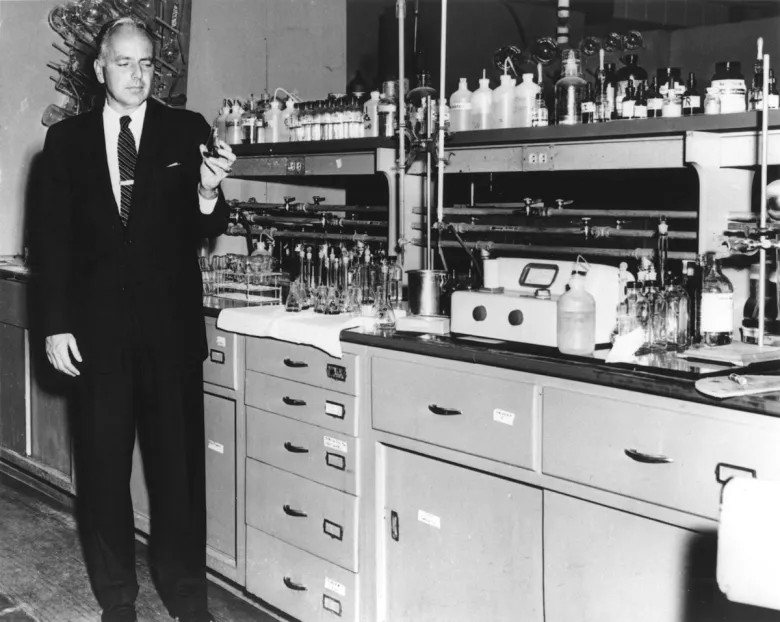 Tom Slick featured in the San Antonio Report 2025
who worked on the formation of the United Nations was on a plane from NZ to San Francisco,
the city where the United Nations charter was hammered out, four days before the UN was to
vote on the Partition of Palestine? Did you further know that he was traveling
with famed Yeti hunter Tom Slick who founded the Southwest
Gas Town is the agentic AI orchestrator, Daize, the 15 year-old here, and I use for
Research Institute? Me neither. Tom Slick is just a part of the network flushed out in
The Gladych Files. When I turned agentic AI loose on his travel manifest, this pciture of
the history of the
world at the time fell into the book as a result of looking into Tom's fellow passengers.
Tom Slick featured in the San Antonio Report 2025
who worked on the formation of the United Nations was on a plane from NZ to San Francisco,
the city where the United Nations charter was hammered out, four days before the UN was to
vote on the Partition of Palestine? Did you further know that he was traveling
with famed Yeti hunter Tom Slick who founded the Southwest
Gas Town is the agentic AI orchestrator, Daize, the 15 year-old here, and I use for
Research Institute? Me neither. Tom Slick is just a part of the network flushed out in
The Gladych Files. When I turned agentic AI loose on his travel manifest, this pciture of
the history of the
world at the time fell into the book as a result of looking into Tom's fellow passengers.
The video is a log of a work session where Mota, (the internet alias the 13 year-old uses), put together that programming with Gas Town, once you get it working at all, is far more like playing a video game than programming. You know, with a lot of up front specification Daize, Mota and their sister Tawnse, the kids whose dad I am, are all featured in Cootermaroos documentation, but still.
In the ham radio high frequency bands, we use the ionosphere to skip radio waves over the horizon and hence, around the world to communicate with other hams. Skip communication channels like these are also used by financial trading firms, the military, and other enterprises for global communications. The value of this natural resource led to the US Department of Commerce creating and maintaining an almost 500 page monogrpah titled "Ionospheric Radio Propagation" written by Ionospheric Radio PropagationU.S. Department of Commerce[pdf] Kenneth Davies and to the NOAA monitoring space weather including the height and critical frequency of the ionosphere's F2 layer—the layer of the ionosphere commonly use for skip communications—in real time.
Skip communications are enabled by the sun well, ionizing, the ionosphere, during the day, and therefore
 The Gladych Files
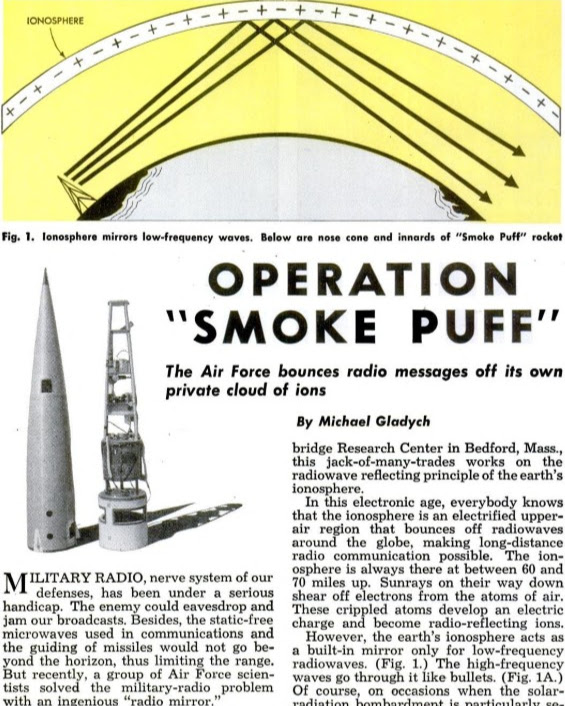
are not as effective at night. In the 1950s, ionospheric communications were so important to the US military
that they commissioned an experiment to attempt to artifically create ionization at night using chemically loaded
missiles that detonated in the F2 layer. The experiment was reported on by Michael Gladyich.
The Gladych Files
are not as effective at night. In the 1950s, ionospheric communications were so important to the US military
that they commissioned an experiment to attempt to artifically create ionization at night using chemically loaded
missiles that detonated in the F2 layer. The experiment was reported on by Michael Gladyich.
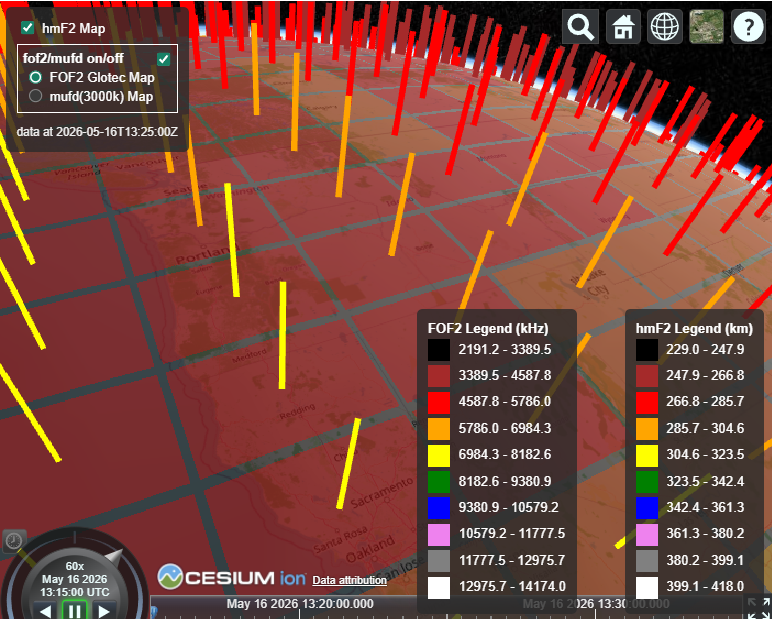
In this project, KO6BTYH—my 13 year old daughter—and I used generative AI and
CesiumJS to display F2 conditions as captured by the NOAA on a
global map.
Want to talk about a deployment-engineer role? Email me or grab my resume.